Thank you all so much for your love and support.
Rodney’s blog will remain online but there will no new posts or further comments on this blog.
Sharing so much with you has meant so much to us both.
Love and blessings, Marcia.
Tuesday, 20 October 2015
Friday, 28 August 2015
'Bye
It is
never easy to write a good-bye letter even when you know when you are
expected to leave. When you don’t, it becomes almost impossible. I
would compare this to letters between spouses written during the war:
the desire to be upbeat and so present a cheerful front while on the
other a hand a need to share the terror.
At least
there is one question I can ignore: that I shall survive: answer – no.
But that leaves when and how painful.
My
incredible doctor popped in yesterday; he will never know how much
that meant to me. During the course of the conversation, he asked me
if I was feeling fearful and I was forced to say ‘no’. It would
have been dishonest but I am grieving for all the friends to whom I
shall be saying good-bye in the coming weeks, if only I knew how long
that is going to be. Yes, I am surprised at how quickly things have
deteriorated.
So is
this? Probably unless thing change for the better. So, let us treat
it as one. Thanks for your support and please keep it coming.
Much love
to you all, thanks for all the fish and farewell.

Friday, 21 August 2015
A River Trip
On the basis that most of you will never have seen the River Dart, Roger and I thought it would e rather fun to take you on a boat trip down to the mouth of the river and then back as far as the Higher Ferry.

We are now in the mouth of the river looking back towards Castle and St Petrox Church.

This might not be particularly photogenic but is of extreme importance to the seamen who use the river after dark. A series of leading lights, of which this is the first, guide them safely into the harbour itself.

A glimpse up Warfleet Creek at the head of which is the old Dartmouth Pottery now converted into luxury accommodation.

As we move inland we see some of Dartmouth's most prestigious properties hanging on the steep hillside.

Low tide reveals narrow beaches.

Somewhere in this picture you will find Evie's Merchant House and, crouching on the foreshore, her boathouse.

We are now opposite the North Embankment. The yellow coloured building is the old station cafe on the end of the Boat Float.
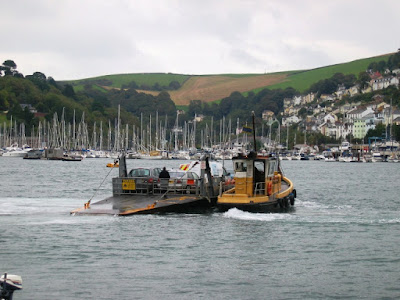
Roger, very sensibly, gave the lower ferries a wide berth. The ferryman are superb but these ferries are extraordinarily difficult to control.

Last year a fully refurbished and gleaming paddle-steamer, The Kingswear Castle, returned to the river after an absence of many years.

A general view of the town of the town looking over to the North Embankment with the Britannia Royal Naval College on the skyline.

All aboard for Paignton.

The Higher Ferry.

We are now in the mouth of the river looking back towards Castle and St Petrox Church.

This might not be particularly photogenic but is of extreme importance to the seamen who use the river after dark. A series of leading lights, of which this is the first, guide them safely into the harbour itself.

A glimpse up Warfleet Creek at the head of which is the old Dartmouth Pottery now converted into luxury accommodation.

As we move inland we see some of Dartmouth's most prestigious properties hanging on the steep hillside.

Low tide reveals narrow beaches.

Somewhere in this picture you will find Evie's Merchant House and, crouching on the foreshore, her boathouse.

We are now opposite the North Embankment. The yellow coloured building is the old station cafe on the end of the Boat Float.

Roger, very sensibly, gave the lower ferries a wide berth. The ferryman are superb but these ferries are extraordinarily difficult to control.

Last year a fully refurbished and gleaming paddle-steamer, The Kingswear Castle, returned to the river after an absence of many years.

A general view of the town of the town looking over to the North Embankment with the Britannia Royal Naval College on the skyline.

All aboard for Paignton.

The Higher Ferry.
Friday, 14 August 2015
Writer's Block
Under
normal circumstances I know what I am going to write about for the
Friday blog by Thursday evening at the latest. Indeed, in many cases
The blog itself is written on the Thursday.
Then
we have the exceptions: the days when I just have to hope that
something will come to me early on Friday. The fact remains that for
the last four years or so, I have found something to talk about in
time – but not this week. This week I am suffering from writer’s
block – that terrifying time when no matter what you do your brain
remains a stubborn blank.

I
am often asked how to cope with writer’s block (although I really
don’t know why people think I know the answer. I always say that I
am a firm believer in ‘hitting the keys’. It doesn’t matter
what you write so long as you hit the keys and the odds are that,
sooner or later, you will find that what you are writing is beginning
to generate the ideas you so desperately seek. Then you can delete
everything that doesn’t matter and away you go. Anyway, that’s
what I am doing now.

I
would like to be able to report that as a result of hitting the keys
I have come up with something really fascinating to talk about but
that simply isn’t true today so I will just tell you what little
news there is.
Marcia’s
copies of the books arrived from Transworld the day before yesterday
and so the sitting room has, once again, been turned into a temporary
warehouse. Marcia gives one each to her son and her sisters but if you
give books away locally you are undermining the book shops who are
finding survival at the moment pretty difficult. When the books are a
few years old, we give any that still have to one of hospices who
have charity shops.

Meanwhile
everyone is busy working out the logistics for the signings this
year. It all happens bang smack in the middle of the holiday season
when the roads in the south west are bursting with visitors and, more
to the point, so are the car parks. Then matters are complicated
because Marcia doesn’t want me left alone for any longer than I
must be. However, the fact remains that if you want to be able to
guarantee a parking lot in Tavistock on a summer’s Saturday
morning, you will be there before 9.45 – even though the signing
does not begin until 11 – and there is no point in arriving only to
find there is just no where to leave the car. The trouble is that you
then have to take a decision: join the queue at one the large car
parks and hope that you will find a spot in time or trawl around the
smaller ones hoping that you will be lucky and someone will pull out
at the right moment. This is not the sort of stress Marcia wants just
before a signing!

Before
I wind up this miserable blog, may I say a big thank you to all of
you who leave comments in the blog or who send in emails. Your
support has been tremendous and I am very lucky to have it. Please
don’t stop just yet.
Friday, 7 August 2015
Novelists at literary festivals
Marcia
once gave a talk at the Porlock Literary Festival and a reader who
lives on Exmoor emailed me earlier this week telling me, amongst
other things, that she had attended that festival.
 |
| Marcia at the Porlock Literary Festival. |
Ways
With Words is the annual literary festival held here at Dartington
and they have only just packed up and disappeared for another year.
Anyway, thinking about that email and the WWW festival made me ponder
on the value of such festivals. It’s fine for people who are in the
public eye – or want to be – but they are rarely professional
novelists who write for a living. Indeed I am tempted to say that
they sell books because of who they are rather than because of what
the books are. Which is great, I have no problem with that.
 |
| Ways With Words. This tent is where Waterstones have speakers' bok available for signing. The entrance to the Great Hall is to the right. |
From
the creative novelist’s point of view, attending a festival is
rather like being a hermit crab pulled out of its shell: the feeling
of exposure is immense. All the creative novelists I have met are
people who work alone and who put a huge amount of themselves in
their books. Having done that they see no point in talking about
themselves – they would far rather that the books did that on their
behalf. In any event, such novelists have only one story to tell: how
they became novelists. This means that there is no point in them
attending any festival more than once: the same people come year
after year.
 |
| Time for a litle somethng. |
They
can’t really talk about the books they have written as can a
politician or an historian. It may seem odd but once a book is done
and dusted it is almost forgotten and to try to talk about them is
almost impossible. I remember Marcia and I were in Rumour in Totnes
some years ago when a slight acquaintance came up.
‘I
have wanted to ask this for a long time,’ she said. ‘What
happened to Claudia in the end?’
‘Who?’
asked Marcia.
‘You
know, Claudia Maynard.’
‘Sorry,
I don’t know anyone called Claudia Maynard.’
At
which point, mercifully, said acquaintance's friend, who had been
paying their bill, bustled up and whisked a very puzzled reader away.
It
is said that one person can know no more than a hundred and twenty
other people properly. For this reason most military organisations
break their forces down into units of that size – in my day an
infantry company would have somewhere about that figure – and in
some big commercial operations they too arrange to divide the
workforce into groups of about that number under a manager. I am not
quite sure how many characters Marcia has created but there are a lot
more than that: probably about eight hundred. It is hardly surprising
that she forgets some of them with a decent prompt. Now, if that
reader had asked, ‘I’ve often wondered about Claudia Maynard in
The Dipper. What happened to her in the end?’ it would have made
the right connection for Marcia – although I very much doubt
whether she would know just what did happen to Claudia. It could be,
of course, that Claudia will suddenly appear at Marcia’s shoulder
and tell her.
I
know we have dropped the weekly blog dog but there are times when I
receive a few dog pictures I feel really should be shared so here are
three. These guys belong to Denise Connolly. She lovingly
calls them "the three hooligans".
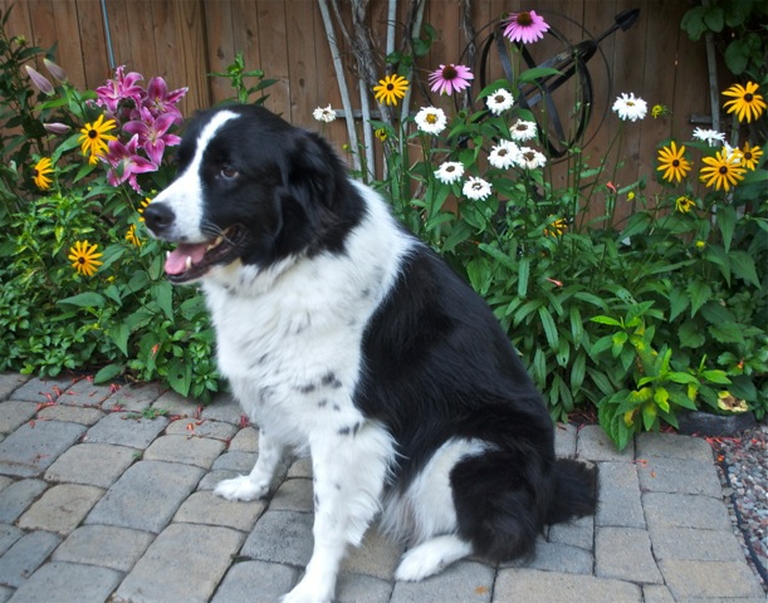
This
is Dakota. He will be five years old the end of October. We adopted
him when he was 3 months old. He was rescued from a high kill shelter
in Tennessee and brought with 34 other puppies to our local shelter,
a NO KILL shelter, that I support with a few large checks every year
and I do fund raising for them also. Dakota is a border/aussie/great
pyrenees mix. A BIG baby!

This
is Teddy. He's about 3 years old. We adopted him when he was 6-7
months old. He was in a high kill shelter in Kentucky and
rescued by the Danbury Connecticut Animal Welfare Society. He's a
aussie/spaniel mix.
Super smart boy!

And our third dog,
adopted this past May, is Scotty. He was also from Kentucky and on
the KILL list for that week when our local shelter manager grabbed
him and a few older dogs and 29 puppies. Our vet says Scotty is about
2 years old. He thinks he is my body guard. We fell in love with each
other instantly! This is the first small breed dog I ever had. He has
the heart of a lion! He's some kind of terrier mix. So playful, can
dance across the room on his hind legs and loves his squeaky toys.
PUBLICATION EVENTS
Thursday 27th August at 11 am: Book signing in the Totnes Bookshop.
Friday 28th August at 11 am: Book signing in the Harbour Bookshop, Kingsbridge,
Tuesday September 8th from 5.30 to 6.30 in the Flavel Hall, Dartmouth. . This is an opportunity to come and meet Marcia Willett. Organised by Dartmouth Community Bookshop and Dartmouth Library.
PUBLICATION EVENTS
Thursday 27th August at 11 am: Book signing in the Totnes Bookshop.
Friday 28th August at 11 am: Book signing in the Harbour Bookshop, Kingsbridge,
Tuesday September 8th from 5.30 to 6.30 in the Flavel Hall, Dartmouth. . This is an opportunity to come and meet Marcia Willett. Organised by Dartmouth Community Bookshop and Dartmouth Library.
Friday, 31 July 2015
The Cloud of unknowing.
You
jolly nearly didn’t have a blog this week.

I
am extremely cross with myself, but the other morning, Wednesday, on
my way to the bathroom for the first time that day, I completely lost
balance. In trying to regain it I managed to crash into one door
frame with my left hip, then into another with with my right arm
before ending up on the floor. Apart from the fact that I am now so
stiff I can hardly walk it is yet another reminder that as we get older
a fall can have terrible consequences. This time I was lucky and I
shall now try to take more care. I am pretty certain that these
sudden losses of balance are as a result of the cocktail of drugs I
am presently swallowing.

It
has, or course, slowed up work on the companion. I have now finished
all the Country pages bar one (Indian Summer) and I had rather
hoped to see that finished this week so that I can get on with the
next section: the characters. Whether or not these will be in the
form of family trees or not I have yet to decided but I do know that
it gets very difficult keeping track of them all. I am hoping that
there will be a bit of very clever technology that will enable me to
do what I want.


It
is nearly seven o'clock on Thursday evening and I am lying on the bed
in my dressing room looking over a blue sky, framed on the left by
the huge oak tree in our garden and at the bottom by a fir tree and a
flowering fruit tree (I think not a cherry) the other side of our
neighbours' cottage and of that all I can see is the chimney with
some new cowls fitted recently. It hasn't taken long for both crows
and gulls to use these little domes as an excellent look-out. I use this as a day bed when I can't get around as I feel the change of view - and atmosphere - is good for me.

The
window faces due south so the sun is shining brilliantly on the
cumulus clouds that are constantly forming and reforming (while some
are just dissolving until nothing is left) as they move gently from
right to left pushed by a fairly gentle westerly wind. According to
the Cloud Appreciation Society, the average life span of a cloud is
no more than eleven minutes. I am sure they are right but there is
one near the horizon that has been entrancing me for over twenty
minutes. I know, I know - eleven is an average. This
fellow had been subtly changing his shape and the valleys and hills
are being wonderfully lit by the sun now dropping to the horizon.
What a way to end the day.

I
wonder how many people have heard of this society? The first time I
came across then they had decided that they had discovered a new type
of cloud and the were trying to have this acknowledged by the
authorities. In this they succeeded but more to the point they
produced one of those documentary films that combine great charm, are
visually stunning (in this case the actors were the clouds) and leave
you feeling that the world isn’t such as bad place after all. You
are also left feeling that the actors were the clouds) and leave
you feeling that the world isn’t such as bad place after all. You
are also left feeling that those who run the society are nutters – very nice nutters, but nutters all the same.

I started with the title, 'The Cloud of Unknowing' because I knew I would want to come back to it. It was first written in the middle ages (the writing rather suggests the late 1400's) but as to who wrote it, we shall never know. It was the first known guide to contemplative prayer. There are many books offering various translations and takes on the subject but it is one of those that will go on attracting people to add to that group of somewhat esoteric Christian thought.
I have found God in many places and very rarely in a church but there are some among us who who do make a connection using the sort of contemplative prayer outlined in The Cloud of Unknowing.

I started with the title, 'The Cloud of Unknowing' because I knew I would want to come back to it. It was first written in the middle ages (the writing rather suggests the late 1400's) but as to who wrote it, we shall never know. It was the first known guide to contemplative prayer. There are many books offering various translations and takes on the subject but it is one of those that will go on attracting people to add to that group of somewhat esoteric Christian thought.
I have found God in many places and very rarely in a church but there are some among us who who do make a connection using the sort of contemplative prayer outlined in The Cloud of Unknowing.
Friday, 24 July 2015
More ramblings from Rodney
I
continue to brood on Mili’s question. After a while you realise
that there is no precise centre in any society for any activity.
 |
| Trees this week - just some rather nice trees. If I have usedd these before, I apologise. |
A
simple answer when thinking about politics would be ‘Westminster’
or ‘Downing Street’ or even ‘The Houses of Parliament’ but
that is not true. Up and down the country there are councils charged
with the mundane day-to-day provision of services. Oddly this is an
extremely difficult task or, to be more precise, delivering all the
services to the satisfaction of all the people is extremely
difficult. Without all these other centres our society would fall
apart. Actually you can divide people into two (this being rather
simplistic): those who when thinking politics do think 'London' and those who think about what is happening
at either county or district level. It all depends on what effects
you most.

When it comes to
sport, I suspect that each sport has a precise centre. Not being a
great follower of sport I can’t talk outside the few I know
anything about.

Tennis: Wimbledon without a doubt – it was the birthplace of tennis and should be the precise centre for the world let alone the UK.

Rugby: here you have a problem because rugby is divided into national teams (even when playing in the world cup) but for England that it Twickenham. Scotland looks to Murrayfield in Edinburgh while the Welsh have the most modern ground in the Millennium Stadium in Cardiff.


Tennis: Wimbledon without a doubt – it was the birthplace of tennis and should be the precise centre for the world let alone the UK.

Rugby: here you have a problem because rugby is divided into national teams (even when playing in the world cup) but for England that it Twickenham. Scotland looks to Murrayfield in Edinburgh while the Welsh have the most modern ground in the Millennium Stadium in Cardiff.

And so it goes on, no
matter what context you choose the high probability is that there are
going to be a number of candidates for ‘precise centre’. After
brooding on this off and on for the last fortnight, the only one I
could come up with was Wimbledon so perhaps that should stand for the
UK as a whole.


It is, I
suppose, inevitable that one looks back over life when you are
somewhere near the end and find yourself pondering on the things you
did that you are still glad you did and those you really,
really wish you had not.


“The
Moving Finger writes; and, having writ,
Moves on: nor all thy
Piety nor Wit
Shall lure it back to cancel half a Line,
Nor all
thy Tears wash out a Word of it.”

When you think about it old Omar hit the nail on the head. One thing pleases me enormously: I know nobody who I really hate and the ones that come close to that are politicians who have done things that I consider to have been morally unacceptable. Top of that list would be Tony Blair for his support in two wars I feel we should not have fought: Iraq and Afghanistan. Even then I don’t really hate the man even though I do hate some of the things he did.

Meanwhile I have met many people who have proved
to be delightful and who have given me great pleasure: I hope that I
reciprocated and they got something from me. Some seem to find that
most of the people they meet are generally unkind and unfriendly. I
find that hard to believe: ask yourself this, ‘how many really
nasty people do I know?’ Quite: the
vast majority of people are fine – the problem is that the
headlines and airwaves tend to be cluttered with stories about the
few that have gone off the rails and this distorts the way we see the
world.


There are quite a few unpleasant and nasty people
in Marcia’s stories but by the end of each book all such characters
have also demonstrated that they really could not help themselves
(Tristan in Postcards from the Past)
or that they wanted to do everything they could to mend their ways
and atone for what they had done (Gillian in The
Courtyard).


As to the few sins of
commission I can remember committing, I did what I could to atone for
them but nothing can ‘wash out a Word of it’.


What does bug me is the
sin of omission: things I could have done but for one reason or
another didn’t and now, of course, it is far too late. It was too
late when I walked away in the first place.


One in particular: a
friend of mine was going on a short cruise from Chichester (where he
kept his boat) over to France and then west to the Channel Islands
before returning home. Would I care to join him with two others? At
the time I had just started rehearsals with the choir I then
conducted (we were to perform The Crucifixion by Stainer) and
this would have delayed matters for a fortnight. So I refused. What I
should have done was to get the organist to stand in for me (she
would have been quite able) but . . .


The Companion is going
well and I am beginning to think that I shall have time to finish it.
Certainly until it is done I shall fight this tumour with everything
that I have got. It is my tribute to Marcia and so very dear to me.
Back next week.
Subscribe to:
Posts (Atom)